It's about commitment, not compliance...
Striving for continual improvement generates a strong culture, and business benefits too!
I feel immensely privileged to be a consultant. I work with clients involved in interesting, challenging and diverse industries – and regularly have opportunities to meet new people, visit new places and learn new things.
It also helps that I’ve also noticed a real shift in attitude in recent years. It doesn’t seem too long ago that lots of business owners would grimace when they had to talk about “elf’n’safety” and viewed their responsibilities as a necessarily evil (and huge cost) that simply got in the way of getting the job done. It often felt like I was similarly viewed as just a nuisance. Maybe I was. Maybe I still am!
I hardly ever encounter those attitudes now. In fact, most of the people I work with demonstrate a clear commitment to health and safety. I am frequently challenged by my forward-thinking clients to help them strive for excellence; only in the last few weeks I been asked for advice on requirements for carrying gas cylinders through road tunnels, consulted on trials for lone-working apps and asked for assistance in identifying suitable dust extraction to reduce workplace exposure.
Some clients are beginning to realise and feel genuine business benefits from their commitment to health and safety. Not only does it give businesses an edge over their competition, but reduced labour costs and improved efficiencies are being experienced too.
These clients are always keen to demonstrate commitment, not as a cynical marketing strategy in search of these commercial advantages, but because their commitment leads to the ultimate success; ensuring people remain free from harm. It is simply the right thing to do.
So what does true commitment actually look like? Perhaps more importantly, what does it feel like?
I recently completed a pretty positive site inspection for a client. Most things got the thumbs up, but the site manager did acknowledge his record keeping could be improved. Soon after the report was submitted, the MD asked for some help on finding a practical solution that would streamline things, without compromising on compliance.
Among other things we discussed, I suggested a simple, branded site-safety board that provided document display and storage functions. Without the need for me to cajole or convince, the Managing Director went ahead and ordered the board. He got it; the board sets the right tone and ensures everyone’s first exposure to safety on site is positive and clear to understand – whilst giving the site managers a simple tool for keeping their paperwork in order.
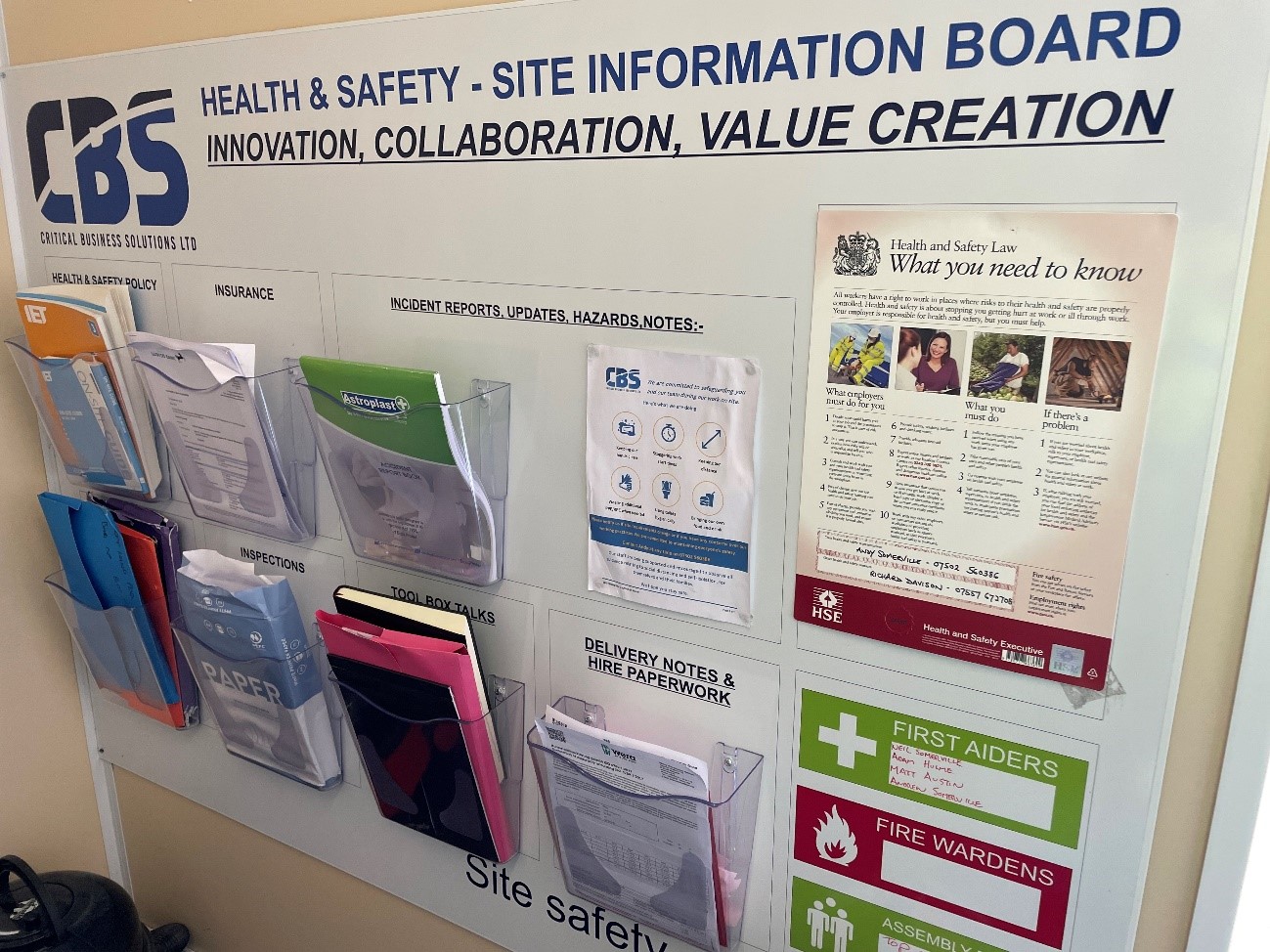
Among other things we discussed, I suggested a simple, branded site-safety board that provided document display and storage functions. Without the need for me to cajole or convince, the Managing Director went ahead and ordered the board. He got it; the board sets the right tone and ensures everyone’s first exposure to safety on site is positive and clear to understand – whilst giving the site managers a simple tool for keeping their paperwork in order.
Perhaps more importantly, he also got that true commitment is about challenging the status quo; about seeking ways to drive continuous improvement rather than simply sticking to the way things have always been managed.
I returned to site a few weeks later and noticed several significant improvements. Without any input or guidance from me, the MD had consulted with site managers and staff to identify and implement some new measures.
The first I noticed was simple but incredibly effective. Site activities involved electrical installation in small, portable units. Festoon lighting was available, but equipment installation constantly changed the internal layout, meaning work areas were often dimly lit or heavily shadowed. To address this, wireless, magnetic, rechargeable task lighting had been issued to every engineer – immediately addressing stress related issues arising from poor illumination and significantly reducing risks of slips, trips and falls and eye strain.

A few minutes later, an enthusiastic engineer was keen to tell me all about the new “strut-slayer” he was using to cut uni-strut. Just have a look at it in action:
The use of the tool is not without its own risks, but it has virtually eliminated cutting operations involving chopsaws and hacksaws. In one positive action, the company has hugely reduced risks associated with noise, vibration, ejected particles, contact with blades, cutting discs and sharp edges.
The moderate financial investment in this equipment is impressive, but the time, effort and care invested into finding these improvements and giving everyone access to them is more significant and reflects this company’s progressive values. None of the previous arrangements for lighting and cutting were inherently dangerous or breaching any regulations. The company could have accepted previous arrangements as the norm and acceptable. But they didn’t. They saw an opportunity to help make their employees safer and took it.
Immediately being put off by cost or inconvenience shows little commitment. Foreseeing and taking action to realise benefits for everyone shows huge commitment.
The company’s employees were clearly impressed with the equipment and grateful for being provided with it. Not only do they like their cool new tools, they obviously feel cared for and recognise how their safety is valued. Ultimately this company’s primary motivation will be achieved; fewer people experiencing harm in the workplace.
But guess what? Installations are being completed quicker and to a higher quality. There is less waste from cutting operations. The business is benefitting commercially too…
The right approach to health and safety can help a business thrive, rather than just survive
Keen to go beyond simple compliance and strive for best-practice in your health and safety management? Give us a call…
Quick Links